Category: Social Justice

  • Language, Warfare and Lawfare – Gaza in Perspective

    by the Very Revd. Canon Professor Martyn Percy, Fellow at University of Edinburgh, King’s College London & Harris Manchester College Oxford

    An obvious observation to make is, ‘what perspective?’ There seems to be so little on the current crisis engulfing Gaza and beyond, only noise, solidarity-signalling and fury matched by long silences and the unsaid. There are plenty of points of view, to be sure. But they’re not quite the same as perspectives.

    The terms ‘perspective’ and ‘point of view’ are frequently used as though synonymous. They are not. A point of view is a space or place from which a story is told or unfolds. A perspective, however, is the analysis of the events and actors, and their motivations, beliefs and conduct. Perspectives can take account of worldviews, culture, heritage and experience. While a point of view might assert or argue the ‘when’, ‘who’ and the ‘what’ of history, a perspective should offer illumination on the ‘why’, ‘how’ and intended meanings of sources.

    So when a group of prominent Jewish lawyers recently published a letter (Financial Times, 17 October) and issued a statement from the Balfour Project, it was immediately apparent that this was a perspective worthy of heeding. Lord Neuberger, Former President of the UK Supreme Court, Philippe Sands KC, Sandra Fredman, University of Oxford, with several others, argued that the laws of war must guide Israel’s response to the Hamas atrocity of October 7th:

    We write as Jews, many of us with family and friends directly affected by the tragedy that has befallen Israel. Like so many others, the vile crimes perpetrated by Hamas in Israel have shaken us to our core. We also write in our capacity as lawyers. We do so because, instilled with our Jewish values, we believe that law, and the adherence to the rule of law, provide an invaluable guide to begin to make sense of what we are witnessing and to provide a path to govern responses to it. In these darkest of days, we write to emphasise the importance of international law as a guide to all.

    In their published statement, they go on to say that “one war crime must not…be avenged by committing another”, and that

    …nothing can justify the ‘complete siege of the Gaza Strip’ declared by the Israeli Government. Denying electricity, food, water, medicine and fuel to a civilian population is a war crime committed by a state… All human life is equal.

    The authors note that Gaza is the most densely populated land on our planet and, as the occupying power, “Israel has a clear legal obligation to safeguard the welfare of the civilians” yet by an “unprecedented aerial bombardment and threatened ground offensive, Israel is inflicting horrendous loss of life on over two million civilians”. Others will claim the rules of war allow for an entirely different perspective, and may argue that action in the cause of self-defence, even proactive, is legitimate. That the ends justify the means, no matter the cost.

    Where mediation may yet help all the parties out of this apocalypse, it will be the law that resolves the crisis. The Balfour Project statement was judicious in referring to Jewish law and our shared obligations under international law. At this moment, that emphasis is right and proper. Yet ancient Jewish law also offers a helpful perspective on the present conflict, not least because, at core level, this is part of our shared legal ecology across the developed world.

    In the New University Library at St. Andrews, Fife, affixed to a wall, is a quotation from James Wilson, dating from Philadelphia in 1768. Wilson grew up in Fife. In the New World he became a leading legal authority who helped to frame the independence declared from 1776. His words are bold in their simplicity:

    All men are by nature equal and free. No-one has a right to any authority over another without his consent…lawful government is founded on the consent of those who are subject to it.

    Contemporary readers of Thomas Paine’s influential pamphlet Common Sense (1776) are frequently surprised by the amount of space he devotes to scriptural reasoning. Paine, a British-born but pro-American independence politician, noted that, for the ancient Jews, monarchy was an idolatrous delusion contrary to Mosaic Law. In the Old Testament, strong, singular, entitled and unaccountable leadership was forbidden.

    Instead the Israelites’ preferred form of governance was that of the Judges – Joshua, Gideon, Deborah and others – who placed themselves under the Law, clear that it was “the Lord God who rules over you”. Gideon declined to be anointed King (Judges 8), telling the Israelites that kingship was not theirs to bestow upon him. Gideon was opposed to dynastic, inherited kingship, regarding it as ‘heathen’.

    The Old Testament promoted an alternative – a form of ‘positive liberty’ that was based on a just social order (c.f. Isaiah Berlin, Four Essays on Liberty (OUP, 1969), pp. 118-172). Leviticus, for example, demands that those who lose their livelihoods are supported by their neighbours. The lives, lands, and livestock of the vulnerable are protected. The Old Testament holiness code is one that promotes interdependence.

    The holiness code also limited the power of any monarch or ruler. A king must be one of your kin (Deuteronomy 17:14-20), and not above the citizens. Crucially, the only role the monarch has is to study, practice, dispense and obey the law. Please note, our leaders today – whether elected or imposed – should be upholders of the law, not lobbying the Court of Appeal trying to change law in order to secure conservative right-wing political cache.

    Old Testament laws were regarded as directly mediated from God. As the covenant between God and humanity, they transformed a legal code into collective sacred duty. The covenant reminded Israel of its fate when it was denied rights and legal protection:

    …remember when you were a slave in Egypt…God redeemed you from there. I, God, therefore command you to observe and protect the rights of the orphan, widow, alien and vulnerable (Deuteronomy 24: 18-22).

    What was crucial to Jewish identity (and arguably remains the case) is not whether an individual believes in God, but rather, do they observe the law? The obligations to follow the law are fundamental.

    Today, this attitude to law has transmuted into a much wider fundamental respect for judges, legislature and the jurisdiction of the state. We believe it is the law that is the ultimate authority, with politicians, including any President, constrained by their constitution.

    Which brings us to Gaza. Since 1650 BCE it probably ranks as one of the oldest continuously occupied cities in history. In old Arabic, its name means ‘fierce, strong’. Conquered by ancient empires – Egyptian, Greek, Roman, Assyrian, Philistine, Canaanite and Persian – by the time of Jesus’ ministry, it was a model of diversity with a multi-ethnic governing assembly.

    Gaza is cited by name in Jewish, Christian and Muslim sacred writings. Sometimes it is just a geographical reference, and no more. The Ethiopian Eunuch – a black, African transgendered individual whose name we never learn, became the first recorded African convert to Christianity (Acts Chapter 8) while travelling in a chariot on the road between Jerusalem and Gaza.

    Over the last two thousand years Gaza city has been held by the Byzantine and Mongol empires, captured by the crusaders, and conquered by Islamic and Ottoman forces. Today, around two million people live there – a mixture of Sunni Muslims and Palestinian Christians, comprising Protestant, Anglican and Roman Catholic. Several hundred thousand live in one of the eight refugee camps in the territory, after exile from the Arab-Israeli conflicts of 1948, 1967 (Six Day War) and 1973 (Yom Kippur War). The Gaza Strip was ceded to the Palestinian Authority under the terms of the 1993 Oslo Accord, with Israel finally vacating possession in 2004.

    In the wider Gaza province and suburbs, the population numbers around two million people, crammed into an area the size of Sevenoaks in Kent. Incidentally, Sevenoaks has a population of 29,000 – and one need not dwell too much on what expanding a Kentish town’s population by close to one-hundredfold might do to a sitting Conservative MP’s prospects at the next election.

    So far as we know, Jesus never visited Gaza. Yet he was well-acquainted with places and peoples who had been subjected to multiple illegal occupation, exile, invasion and domination. One could say that Jesus’ entire ministry is spent among an assortment of the dispossessed, disinherited and decimated. Yet the core proclamation from this young rabbi was essentially one of peace and justice.

    Jesus came from Nazareth (Galilee), but his birth was in Bethlehem, Judea. But had there been no census at Bethlehem, Jesus would have been born in Galilee. This territory was not part of the Roman Empire. Galilee was a ‘client province’ of the Empire, and under the heel of Rome, but allowed to be ruled by the Herodian Dynasty. Herod and his son, Antipas were ‘kings’ in the lifetime of Jesus, but mere puppet rulers there to keep order on the edge of an Empire, granted titles and freedoms in return for loyalty.

    When it came to the trials of Jesus prior to his crucifixion, Pilate washed his hands of the affair because Jesus, as a Galilean, was not subject to Roman law or jurisdiction. Nor was Jesus subject to Judean law. The Sadducees, Scribes and Pharisees wanted Jesus tried under Jewish law, but neither Herod nor Pilate could oblige. The High Priests argued blasphemy should lead to the automatic death penalty, but the only way of achieving that end was to avoid a trial altogether, and judge and condemn Jesus without any due legal process. That is precisely what happens. Remember Caiaphas’ words: “…what need have we of witnesses?!”

    Such was the vengeful hysteria, sentence was passed on Jesus before trial. He was denied due legal process, because were that to have happened, he would most likely have been acquitted.

    The statement from the eminent Jewish lawyers of the Balfour Project is a reminder that the only common ground we stand on in a screaming, violent apocalyptic crisis is uncompromising practice of the law. It is the calm reasoning of human rights and due legal process that need to be heard above the cacophony of shouts for vengeance. The only way to bring about peace – and quiet – is justice.


  • Vile Bodies?

    by Adrian Thatcher, Honorary Professor in the Department of Religion and Theology, University of Exeter and a Trustee of Modern Church

    So now we know! While the authorization of same-sex marriages within the Church of England remains a distant dream, ‘Prayers of Love and Faith’ for same-sex couples are to be commended by the bishops next month for experimental use in stand-alone services. The Church of England Evangelical Council immediately announced that the proposals ‘depart from a biblical understanding of sex and marriage’.

    One of the main sticking points among conservatives throughout the churches is that ‘biblical understanding’ is unchanging. Was the CofE wrong, then, when in 2004 it changed its doctrine of marriage to permit, albeit ‘in exceptional cases’, divorce and what it called ‘further marriage’? Was it wrong to allow a widower to marry his late wife’s sister; or wrong in 1835 to prevent it; or in 1907 to allow it again, having faced down trenchant opposition from conservatives over several decades similar to the outbursts that have been heard in Synod this week?

    If biblical understanding is unchanging then employing and trading in slaves, killing Jews and crusading against Muslims is fine too. Ephesians is pretty explicit: ‘Slaves, obey your earthly masters with fear and trembling, in singleness of heart, as you obey Christ’ (Eph. 6.5). Were Augustine and Aquinas right to deduce from scripture that slavery was instituted by God so that by it certain people could be blessed by learning the virtues of obedience and humility? Were white mainline Protestants biblically sound to invoke the curse of Canaan (Gen. 9.18-27) in summoning biblical support for the convenient prejudice that all black people were cursed?

    Who dares to recall that a favourite proof text of Christian slave owners was the parable of Jesus which illustrates the need for disciples to be watchful for the coming of the Son of Man by means of a slave owner meting out punishment to inattentive slaves, actually cutting one of them to pieces for misconduct (Luke 12.46)? The cutting open of the bodies of slaves by lashing and lynching was a common punishment during the Jim Crow years in the Protestant USA, and the next verse – ‘‘The servant who knows the master’s will and does not get ready or does not do what the master wants will be beaten with many blows’ (Luke 12.47) – offered a persuasive reason for doing exactly what the saying recommended. Being Christian and cruel is fine, authorized by Christ himself.

    This exegetical cruelty – the shameful shadow side of Christianity almost never acknowledged – persists in the present wranglings where scripture is utilized to reinforce cruel prejudice. It is nothing new. ‘His blood be on us and on our children’ (Matt. 27.25), cited Christians, as they hacked innocent Jewish people to death in the name of Christ. Martin Luther’s wicked text, On the Jews and Their Lies, is packed with biblical quotations. Yes, on the basis of scores of proof texts he advised that synagogues be burned, their books confiscated, their worship forbidden, and that they driven from Luther’s country. Yes, if this great Protestant Reformer could advocate these things on the basis of scripture, what confidence can we have in the siren cry, ‘sola scriptura’ heard all around the Anglican communion?

    The time has now come for an investigation into the prior historical and theological causes leading to this Anglican tolerance of prejudice and pastoral cruelty. Such an investigation will uncover that disturbing strand of the tradition that regards particular human bodies as inferior, disgusting, vile, ‘other’. This tradition would explain more than the disdain shown to LGBT people and their arrangements for living in love and faith. It would help to explain the terrible and world-wide abuse of children and vulnerable people by Christian leaders; why the churches covered it up; why racism is still endemic; why women still can’t be ministers or priests in most of the world’s churches; why spiritual abuse operates unchecked; why churches uphold marriage while ignoring the poor quality of life within many of them.

    My new book, just published, has begun this wider, deeper, and necessary investigation. Vile Bodies: The Body in Christian Teaching, Faith, and Practice uncovers an antipathy toward particular human bodies in much Christian theology. It vilifies them, whether the bodies of women, slaves, Jews, Muslims, Blacks, heretics, gays, heathens, people of lower classes. This tradition of thinking about and mistreating bodies is stubbornly entrenched in theology. It manifests itself whenever the church manages to get itself talking about bodies.

    Bridging the distance between biblical times and our own, Vile Bodies examines the psychological abuse of women compelled to see themselves as the downfall of the world; the futile attempts of holy men to deny their sexuality; the elaborate (and entirely biblical) justifications for owning slaves and enslaving whole peoples. It shows how mystical theology plundered the body’s senses in its forlorn attempts to soar above them in the soul’s search for God. It describes the elaborate manipulation of biblical texts to justify the persecution and killing of Jews, soon extended to justifying the crusades, enslaving millions, and colonizing whole peoples.

    Racism, sexism, colonialism, and homophobia follow from the theology that regards some bodies as superior, others as inferior or disgusting. A particular feature of such theology is that it requires self-delusion, constant repetition, the refusal of complexity, and the pretence that cruel and exploitative beliefs and practices are consistent with God’s will. At other times spiritual malpractice appears to be acknowledged (“We sincerely repent”) while the bad theology continues unabated. Alleged fidelity to scripture is substituted for real fidelity to Christ.

    An ‘unknowing’ of this tradition is an urgent task. The inoculation from self-criticism; the priority of apparent unity over the pursuit of truth; the abuse scandals and their concealment to protect the church’s ‘good name’; the hypocrisy that spins pastoral principles while at the same time undermining them; these are the demons awaiting exorcism from the body of the church.

    Vile Bodies: The Body in Christian Teaching, Faith, and Practice, is published by SCM Press on November 30th. Copies at a 20% discount can be ordered here.

  • Unity and the Myth of Neutrality

    by the Revd Dr Charlie Bell, Fellow at Girton College Cambridge, and Assistant Curate, St John the Divine, Kennington

    There is no such thing as ‘neutral’ when it comes to our treatment of other people.

    This is, of course, an obvious truth – one accepted for generations and across thousands of different particular circumstances. Refusing to take a position when it comes to the dignity of others is not morally neutral – it comes with a moral cost. Silence in the face of oppression is complicity.

    Yet this seems to be something that people in the church – whether bishops, other clergy, or lay people – seem far too often to be unable or unwilling to accept. For years, with a few notable exceptions, the church has lagged behind in matters of social justice – acting not as a spur to change or even issuing a call to action, but instead bringing up the rear. Yet we have told ourselves, far too often, that to take a position instead and risk losing ‘neutrality’ is to do a disservice to our role in the world. We convince ourselves that silence is a moral good – often in the name of ‘unity’. Indeed, we convince ourselves that neutrality is possible.

    There is so much wrong with this position that it seems almost embarrassing to engage with it. Taking a step back and looking in at the church from the outside, it becomes increasingly clear why nobody wants to hear anything from us. It is not only our open hostility to things the world takes as read that makes us irrelevant. Our ‘neutrality’ on matters of human dignity entirely compromises our ability to speak out and be listened to as well.

    Silence is one end of the spectrum. A refusal to say anything, of course, is nonetheless a very clear statement. Silence means ‘we don’t have your back, and we draw an equivalence between “both sides”’. It means ‘we don’t care enough about you to stand up for you’. It means ‘you don’t matter’. It means ‘we will protect the institution of the church whilst using you as collateral’.

    Yet silence is only one part of the problem. Alleged neutrality is, in a sense, far more pernicious. And that false sense of neutrality seeps into every aspect of church life. We have seen it in the ‘both-side-ism’ of Living in Love and Faith, and we see it still in the conflation of the vulnerability of LGBTQI people with the vulnerability of those taking a self-professed conservative viewpoint. We see it in false equivalence between the ‘concern’ to keep conservatives in the church and the need to be ‘pastorally sensitive’ to LGBTQI people. Enough with the patronising claptrap. Enough with the falsehoods. We are barred from ministry; our loves are called ‘ungodly and devilish’; our lives are pruriently pored over; we are condemned to second-rate tolerance – at best. We are bleeding LGBTQI people from our church. There is no equivalence here – we don’t want to push anyone away from the Table, we simply want to take our rightful place, each of us created in the image of God just as much as straight people. We want the church to see what is already blessed by God.

    Yet within the church, we have departed so far from the reality of life that people live day to day that we have created our own ‘churchy’ culture that replaces real life with cis, heterosexualist fantasy. And far too many of us participate in it, LGBTQI or otherwise. We give it credence – we tell ourselves and each other how ‘brave’ it is for bishops and others to speak out in even lukewarm terms about LGBTQI people. We dance around ‘the issue’, and we ‘keep our heads down’ so as not to cause trouble.

    One of the most depressing things I’ve noticed in recent weeks is how many self-identifying LGBTQI clergy – and, worse, our allies – seem to have been conditioned into believing that the most we should hope for is the scraps under the Table. I have sat with clergy who fear being ‘too pro-same-sex marriage’ despite living with their partner, who have bought so heavily into the need for ‘balance’ and ‘neutrality’ that they are willing to disown the love of their life in the process. I have been told it’s a ‘step too far’, and that ‘well, we have managed OK’. ‘I’m not sure the church is in that place just yet.’ ‘These things move in long time frames.’ ‘We need some more theology’. ‘Let’s not rock the boat too much’.

    It’s about time to take the blinkers off. The life-giving power of the Gospel is not about ‘privately managing’. ‘We’ might have managed so far, but since when has the church been a church for those already in the institution, those already in the know who can have a ever-so-secret civil partnership ceremony in church, against the rules but allowed with a wink-wink, nudge-nudge. How have we gotten ourselves to a place where we – as LGBTQI clergy and those who profess to be our allies – will not be honest? Much criticism has been levelled at the bishops – and much of that is entirely valid – yet where is the ground-swell of truth-telling from clergy on the front line? Why are we so timid? Have we really drunk the ‘unity’ Kool-Aid, a ‘unity’ that is simply a false neutrality that tramples over queer people in the process?

    The time has come for us to get off the fence – bishops, clergy, laity – everyone. The time has come for us to stop pretending there is something called ‘neutral’, and to call it out. There is nothing neutral about the current position of the Church of England as pertains to LGBTQI people – nothing whatsoever. In refusing to bless our relationships, it says there is nothing good in them – that we are unable to reflect the love of God in the same way that heterosexuals are. It says that we are somehow, innately, disordered. We are ‘less than’. Our love and its human expression is something that needs to be ‘excused’, something we should be slightly embarrassed about.

    There is no neutral position on same-sex relationships – but there is cowardice. And it needs to be called out – in bishops, in clergy, in laity – in ourselves. Yet we continue to let people get away with it. We tolerate their warm words that lead to no action. We nod when we hear talk of ‘unity’, buying into the absurd suggestion that bishops create it and that Christ demands it at any cost – even the lives of LGBTQI young people. We call people supportive who won’t lift a finger to actually support us. We keep quiet in order to ‘keep the peace’. We deny the image of God in others – and far too often ourselves as well.

    No more of this nonsense. It is time for the cycle to be broken. Our mission, our faith, our truth, our love, our relationships, our whole being depends on us loosening the shackles that continue to bind us, and our minds. The church can – must, surely – start to say what we believe it should say. But it’s not going to do it on its own – and if, as members of this church, we aren’t willing to play our part, then what are we for?

    The Archbishop of Canterbury, and other bishops, may be willing to continue to construct the alternative reality of ‘neutrality’ and silence when it comes to the human dignity of LGBTQI people, but we do not have to accept this as the only way. It is not. It has never been so, whatever we have become used to believing that we believe. Rather, let us become the church he speaks of – excepting this issue – as wanting to become:

    ‘We acted rightly, we spoke clearly, and we loved generously and we believed faithfully’.

    It is high time that this became true for our approach to LGBTQI people, our lives and loves, just as much as it is for anything else. To refuse to make it so is surely to cavort and collude with faithlessness, dishonesty and – ultimately – oppression.

    If you sit on the fence too long, it becomes rather uncomfortable. Perhaps it’s time to offer a reminder of that simple fact – and time for the church to become the beacon of hope it is called to be.

  • EvangelicAlly

    by the Revd Jody Stowell, Vicar of St Michael and All Angels, Harrow Weald and member of General Synod

    I became a Christian in the proper evangelical ‘prayed the prayer’ type way when I was 14. And although, looking back, I know that God was not absent for the first 13 years of my life (I always believed in a God, always prayed), that moment was really important in my life with God. In recalling it, I have often said that the story I was told on that night, about salvation and sacrifice and choosing to follow Jesus, was one that I already knew, that resonated with the story already within my soul, and so I said ‘Yes!’

    I didn’t know then that I was not just a Christian, but an Evangelical Christian. Only in my twenties did I start to become aware of the tribal nature of the Church of England, and to meet some Liberal Christians. Contrary to what I’d been led to expect, I discovered that they were, in fact, Christian! I also began my theology degree at Spurgeon’s College as an independent student, with tutors from many denominations. One of my modules was on Spirituality, and it was here that I discovered the wonderful length and breadth of Christian Tradition. Within this tradition, it was clear that I was an Evangelical and that this was part of a whole multi-faceted history.

    Obviously within my Evangelical roots was the idea that ‘homosexuality was wrong.’ I wanted to be a good Christian so, whilst slightly uncomfortable with this idea, I admit that I simply went with it. It didn’t seem to make much of a difference to my own life, so I didn’t have to think about it. As I grew up and as my world expanded, that changed. I needed to connect my theology with my knowledge of who God is and what God is like, and the reality that this affected real people.

    However, at that time exploring the theology of men and women was my priority, as it affected me personally, in my own call to ordination. I found it painful to be ousted from my clan, to be told I wasn’t an Evangelical, to find myself without a home and to feel like I didn’t belong. This still hurts, although with much less sting than it used to, but the experience helps me to understand the emotional processes that are going on, for those who are in the Evangelical tribe, when they even begin to think about standing out for Same-Sex Marriage.  Yes, it is an excuse, but if we do not accept that this is a strong attachment, then we will never be able to have the conversations that encourage and enable people to publicly change their mind.

    It was my exploration of the biblical arguments regarding men and women which took me to places where the conversation was about humanity and our relationships more broadly. There were those in the Evangelical world who closed themselves to the conversation on the ordination of women because they said it was the ‘thin end of the wedge’, calling into question the place of headship in marriage, which is for them, absolute in Scripture. If this could be questioned, then the next thing on the table would be … homosexuality.

    That emotional response to having to think about a possible change in mindset over LGBT+ inclusion sometimes lay at the root of saying ‘no’ to a change of mind on women’s ordination. The argument for women as bishops was often regressed to the question about women’s ordination in its entirety. And, in a way, I understood this anxiety. As I listened to ordained women argue for their place, I often wondered how we could ever be closed to the question of LGBT+ inclusion. It would always be possible for a biblical perspective to be presented that was persuasive. The possibility would never be closed. And this is, of course, the posture of the Christian faith – we are people of revelation and it is really uncomfortable!  In every generation, we must do the wrestling of working out what is good and true and of God and what is ephemera.  But to choose not to wrestle is, I’m afraid, not an option.

    It wasn’t just the reality of revelation and the possibility of persuasive biblical argument that I discovered in exploring a theology of men and women; it was a different reading of an actual biblical story about human relationships, Genesis 2.  My understanding of this story was fundamentally changed by, for example, Phyllis Trible’s God and the Rhetoric of Sexuality (1978).

    Where previously this had been delivered as a story of difference, I began to see the meaning as lying in the expression of shared humanity: ‘bone of my bone, flesh of my flesh’. The focus here is on the sameness. Of course, there is also difference. The Human who lies down to sleep is not the same as the human who wakes up: the Dustling (ha’adam) lies down and becomes the man (iysh) and the other human, the woman (ishshah).

    But this particular difference only frames the focus of the story, which is that men and women have the same humanity. It is understandable that the story uses men and women to illustrate the ultimate difference, but this is about making the point about shared humanity more powerful. It does not necessarily create a defining doctrine regarding who can be in relationship with each other in marriage. We are all ‘bone of my bone, flesh of my flesh.’ When I stare into the eyes of another human, I must be able to say this; to see in them, myself, and to recognise the image of God in the other. Every other human being is different to me, not just those who are not my biological sex; every human being is, in some sense, ‘other’ to me. This story tells me that I must see myself in the woman in the hijab, the boy with the braids, the enby wheelchair user.

    This story has reframed for me all the other stories in Scripture in which the relationship between men and women is at the forefront. It has given me a basis on which to stand in anyone’s company and be their equal, and them, mine.

    It has meant that, in terms of my own humanity, I am assured of my value and my place. And it has given me the lens through which I see my LGBT+ siblings and niblings: ‘bone of my bone, flesh of my flesh.’


  • Just Housing: A Christian Vision

    Just Housing: A Christian Vision

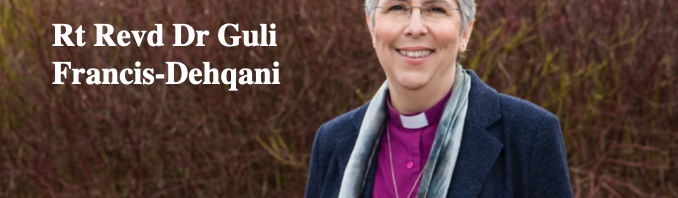
    by the Rt Revd Dr Guli Francis-Dehqani, diocesan Bishop of Chelmsford and lead Bishop for Housing in the Church of England

    As a sign of how important the housing crisis is to the leaders of the Church, last year the Archbishop of Canterbury appointed me as the first Bishop for Housing in the Church of England.

    Although I have no expertise in housing, I know something of what it is to be homeless. I arrived in Britain in 1980 as a 13-year-old refugee, following the impact of the Islamic Revolution in my home country of Iran. Having left with no more than a suitcase each, my family and I were welcomed here and were offered housing in a theological college and then a vacant vicarage. That stability gave us a base and the stability from which we were able to start building new lives.

    40 years later I am responsible for making sure the recommendations of ‘Coming Home’, the report of the Archbishops’ Commission on Housing, Church and Community, are taken forward.

    This is a daunting challenge, but what motivates me is that I’m passionate about the church being involved in working for greater social justice. Since 8 million people in England are living in overcrowded, unaffordable or unsuitable housing (which in turn leads to many other social problems), it seems to me there is a clear call for Christians across all denominations to work towards housing provision.

    The Coming Home report spells out a distinct Christian vision for housing and community. The scriptures tell a story of a journey from a God-provided home, of humanity then becoming ‘homeless’, moving out into a dangerous world, and then of a long process of redemption which leads back home again – but to one that looks different from the first.

    The report unpacked this trajectory and from it developed five core values to characterise all good housing. First the story of Creation and humanity’s role in stewarding the earth means that our housing must be sustainable; the built environment needs to be in harmony with the natural environment, and our housing should be high on quality but low on carbon.

    The pervasive reality of sin means that God’s good creation is susceptible to environmental and social disintegration. Homes aren’t always places of protection, nor communities free from injustice and exploitation. Physical housing can be poorly built, standards compromised, and repairs neglected, which is why good housing will always put a high value on safety.

    Thirdly, the incarnation reaffirms the goodness of the physical creation and the value of human communities having places and spaces where they belong. Good housing should therefore offer stability, where local people can afford to live and put down roots, so they and their families can thrive.

    God’s redeemed people – the Church – represent a new kind of humanity, no longer governed by unjust distinctions based on race, class, gender, sexuality, ability or income. This translates into a commitment to housing that is welcoming and sociable, with hospitable spaces that can help people from different cultures, faiths and backgrounds find a place of connection, and build long term relationships.

    Finally, the vision of the new creation means that although we will never achieve perfection in housing in this age, we can still work towards the one to come, where all is healed and transformed, and God is at home among us. Housing that reflects this means the architecture, design and technology all work together to create satisfying places of beauty that people delight to live in.

    This reflection provides five simple values as the benchmark for the Church’s engagement in the housing sector: good housing is sustainable, safe, stable, sociable and satisfying. The language is accessible for people of all faiths or none, yet there is theological depth undergirding each of the five values.

    An example of a church-initiated response to the shortage of affordable homes has been in Keswick. Back in 2009, Keswick Churches Together hosted a series of open meetings on issues facing the town. Housing kept coming up in these conversations, as many people who were born in the town, had gone to school there, or worked in Keswick, were living in substandard accommodation at unaffordable rents, or were being forced to commute into the town from miles away.

    A working group was assembled to think about the best response to the need for more and better housing, and Keswick Community Housing Trust (KCHT) was set up as a result. The vicar of St John’s Church in Keswick offered to sell them a piece of land next to the church graveyard, and 11 affordable homes were built there. The success of this led to three more developments by KCHT, one of them on land that had belonged to the Methodist Church. Around half the homes are for shared ownership and the other half are let out at rents that are truly affordable in perpetuity – measured in relation to local earnings, not market rents.

    This experience from Keswick was shared with the Commissioners and features in the Coming Home report. We would love to see many more grass roots initiatives like that, so we want to invite you to be part of this journey. We’re setting up a Church Housing Foundation to empower the Church to engage with housing at all levels, and are looking to collaborate with any partners, groups or individuals who share this vision and want to see God’s kingdom expressed through bricks and mortar – delightful homes and thriving communities up and down the country.


  • What is Marriage? Living in Love and Faith… and Denial

    by Rachel Starr, tutor at The Queen’s Foundation for Ecumenical Theological Education, Birmingham

    As someone shaped by Methodist tradition, it has been an interesting experience engaging with Living in Love and Faith (2020). As you may know, the Methodist Church in Britain has spent the past few years debating its own report on marriage and relationships, God in Love Unites Us (2019). There are some similarities, and of course many differences, between the two reports. Both in their own way seek to reflect the changing social context from which and into which they speak. And yet there is little acknowledgement of how church teaching around marriage and relationships has had a limiting and sometimes deadly impact on women and other marginalized groups throughout the centuries.

    My own study of theologies of marriage began while living in Argentina. It was there that I began to see how the everyday violence that many women (and some men) experience within the context of intimate relationships, was legitimated by dominant church teaching around marriage and gender relationships. Living and studying alongside Latin American women theologians and activists helped me to see the everyday violence that occurs in homes, on the streets, and in other contexts. Many of our interactions, structures and institutions are formed and maintained through violence. Such violence may not be obvious at first, but once seen it is difficult to ignore.

    Living in Love and Faith presents an idealized view of marriage, which fails to account for problems perpetuated by Christian teaching on marriage. As one example, the document makes reference to prophetic descriptions of the covenant as a marriage, but does not acknowledge the violence of this metaphor and how it has been used to justify domestic violence over the centuries. This despite decades-long discussion of the violence of these texts by scholars such as Renita Weems.

    To read either Living in Love and Faith or God in Love Unites Us is to be presented with a view of marriage as a vocation, over which churches are divided as to who can be called and who is able to benefit from the gift of marriage. But what if marriage was less of a gift and more of a problem? Of course, marriage can offer stability and friendship, as well as significant social and financial benefits. But some studies suggest that women who marry have a lower life expectancy than single women, whereas men who marry have a higher life expectancy than single men. Such studies suggest that for women marriage is, at a very basic level, life-limiting.

    My concern with how marriage is presented in Living in Love and Faith is that the negative impact marriage can have on women is not acknowledged. While the report does make mention of domestic violence, it seeks to contain what is an everyday reality for one in three women worldwide by literally ‘containing’ the brief discussion of domestic violence (written by myself) in a text box. As such it does not inform the wider discussion of marriage.

    In my own work, Reimagining theologies of marriage in contexts of domestic violence (2018), I explore Augustine’s notion of the good of marriage. Augustine proposed that marriage should be valued because it can generate fidelity, children and lasting union, a view which continues to shape the church’s understanding of the purpose of marriage. In contrast, I suggest that a good marriage is one that is concerned with the bodily wellbeing of both partners, and that contributes to the positive transformation of the wider community. The need for marriage to be life-giving for those both within and beyond it is reflected in Willie James Jennings’ criticism of what he sees as the church’s obsession with married couples. In his commentary on Acts, Jennings argues that for a marriage to be good, it must locate the couple in the wider community, so that there is a shared sense of purpose and distribution of resources. Jennings’ words came to mind recently when I read about the marriage of actor Sophia Bush and social entrepreneur Grant Hughes which took place in Tulsa, Oklahoma in 2022. The couple designed their marriage celebrations around their commitment to social justice, inviting guests to spend time with local activists and artists, all the time asking how their marriage might generate more sustainable, equal and inclusive ways of living.

    In Reimagining Marriage, I look also at two models of marriage which dominant western Christian traditions: marriage as covenant and marriage as sacrament. Both of these are present within Living in Love and Faith and God in Love Unites Us. Yet neither report critically assesses these models or acknowledges their limitations. To summarise from my own research: the covenantal model is marked by exclusion, inequality and violence; and the sacramental model encourages self-sacrifice and limits access to divorce.

    While I recognise the importance of equal access to marriage, I wonder whether it is really the goal many perceive it to be. Is marriage unavoidably problematic, a relationship built on inequality, restriction and control?

    The new Methodist service of marriage, designed for the celebration of marriage between any two people, is a hopeful sign that marriage can be reimagined in more equal ways. The marriage party enter the church together; and since the couple is non-gendered, there are no assumptions about who speaks first.

    Alongside more equal forms of marriage, I suggest that marriage should be reimagined as a place of grace, in which bodies are honoured, everyday struggles are acknowledged, and new more just and equal ways of relating are anticipated. Rather than describing marriage as a sacrament or covenant, perhaps a more helpful, inviting image for today is that proposed by the medieval English theologian Aelred of Rievaulx, who described marriage as a rickety boat, which takes constant work to keep afloat, and which, if it is to survive, must be focused on the common good.

  • Clearing the Slate: The Realities of a Declining Church

    by Fr Alex Frost, Vicar of St Matthews, Burnley and member of General Synod

    In my capacity as Vicar, St Matthew’s Burnley, I sometimes wonder how Urban Ministry is perceived or understood within the Church of England community. Particularly if you are not living in it daily as I do in my parish of over 17,000 people where only the tiniest of numbers attend church on a weekly basis.

    So, what is the perception versus reality in modern day Britain in 2022?

    Maybe one of the perceptions is that urban estates are simply full of lazy good for nothing spongers, who want everything literally on a plate, including food, fuel, and freebies. Maybe the perception is that these areas are full of uneducated layabouts who make their own bed and should lie in it, and if that bed happens to be sleeping bag outside Tesco’s, then it’s someone else’s problem and not theirs. Maybe there is a perception that urban deprivation is all made-up poppycock nonsense and propaganda to build an agenda against a political ideology; just an imaginatively-created fairy tale by the ‘Left’ to create political and social discontent.

    I think one of the key dangers faced by the Church of England with its aura and aroma of middle- to upper-class arrogance is that it takes the moral high ground by believing that throwing clergy and the commissioners’ cash at the problem, Christianity will burst into life like bluebells in greenbelt Surrey.

    The reality is that the pandemic has brought huge issues to Urban settings that already had huge issues long before COVID 19 was even a thing.  Many Urban estates and communities have been dealing with their own localised pandemic and were already rationing toilet rolls and petrol long before the cost-of-living crisis we are facing at present. For many families living at this sharp end of existence, life is simply about surviving from one day to the next. Trust me when I tell you the last thing many of these folks want is some Christians in the Marks and Spencer summer range rocking up on the estate with a ‘vision’ or a ‘plan’ to lead them into still waters whilst Matt Redman belts out 10,000 Reasons on the portable speakers.

    The reality is that our urban settings at times are very tough, at times they are very sad whilst at other times they are funny and joyful. In my past life as a stand-up comedian, I used to think hard about my material, but here on the estates the landscape is a hive of humour and hilarity. Often, it’s a case of ‘If we don’t laugh, we might die’. If we don’t laugh at one other, we might hurt one another. During the pandemic I have felt extremely blessed to walk alongside many of these incredible characters. I’m also very fortunate that I have been afforded the opportunity to give a voice to some of these people via my new book ‘Our Daily Bread’, published by Harper Collins North and out in October. At times the stories are harrowing and deeply upsetting, but underneath all the pain and hardship are some of the most resilient and faithful people you could wish to find.

    They are people that have gone way beyond ‘Been there, got the T-shirt’; they are people who been fully kitted out in a lifetime of challenge, poverty, and let-down. They are all people who have lost faith in ‘services’, politicians, and policing. These are communities who have had so little engagement with faith groups that they have never had the opportunity to discover a faith in Jesus because it’s never even been there as an option. Instead, they have experienced a creaking out-of-touch Church that in many cases only opens its doors to exude a complex fragrance of exclusive traditional theologies that’s as easily lost on newly-confirmed teenagers as it is on a single parent on benefits.

    So where is the hope? One of the great joys of an abandonment of estate ministry by the church is that slates have been cleared like that etch-a-sketch classic toy. The church has been dormant for so long in so many places, that few people know what it was even like, other than the trail of damage that has been left behind by homophobia, bigotry and intolerance. The joy can be found in a new ministry that truly reflects Jesus’ encouragement to love thy neighbour as thyself and serve the most needy.

    We have much work to do at St Matthew’s, Burnley, but our ministry through the pandemic has opened our church doors to a fragile and broken community. We have simply tried to serve, be that food, friendship or faith. Not too pushy, not too judgy, always inclusive, never exclusive, in the hope that our visitors might find something of worth: worth in themselves, worth in each other, worth in our church and in Jesus our redeemer.

    Wherever you are or whatever you believe about the cost-of-living crisis, I can tell you it exists, it is real. It is painful, it is traumatic and that’s what makes it necessary for our national church to do more in our urban settings. Just two sessions into being a newly-elected General Synod member reminds me that we are not doing enough. Only when we place the most marginalised people in our society at the heart of our church will we grow and make a difference. If we don’t, we face a church in palliative decline and our future could be terminal. That’s what is at stake: this is where we are, and for that we must truly repent.


  • Bishops Speaking Out: So Very Right and So Very Wrong

    by the Revd Canon Rosie Harper, Chaplain to the Bishop of Buckingham, former Member of General Synod and Trustee of the Ozanne Foundation


    This is my thoughtful quote of the week: ‘The apostles remembered what many modern Christians tend to forget – that what makes the gospel offensive isn’t who it keeps out but who it lets in.’ So said the wonderful Rachel Held Evans. Her prophetic voice did exactly that. It drew people in. Oh my, do we miss her!

    It’s easy to jump to a pious interpretation of this radical inclusivity of the gospel, but the truth is more incarnational than sacramental. Jesus includes real embodied people, not their notional ‘souls’ (whatever you imagine a disembodied soul might actually be!). Because there are prostitutes and beggars, refugees and tax collectors in Jesus’ life we can’t avoid the message our faith is giving us. That message, because it is embodied, can’t help but be political.

    When the policy of exporting refugees to Rwanda was first mooted, I thought it was a joke. It seemed so off the scale of normal morality that it couldn’t be true. More than failing to welcome the stranger amongst us, a code which most world religions hold dear, the proposal was to export them. It looks like a government-sponsored form of human trafficking. People who are in the most desperate need being sent against their will to a country they don’t want to go to. A country which for many will prove dangerous.

    As a country we badly need more people willing and able to work. The NHS, care services, farms, haulage, airports are all struggling to deliver. We need people, but not, it seems, refugee types of people. The layers of prejudice are astounding.

    All this stirred the hearts and consciences of our Archbishops and Bishops. They wrote a stiff letter which appeared in The Times on June 14th. I’m tempted to say: ‘What took you so long?’ Even Prince Charles pronounced before them. But yes, it was a good and helpful intervention, and yes, for some, this dose of gospel truth was offensive.

    As I write, we have seen a plane loaded with a mere handful of men stopped on the tarmac by the European Court of Human Rights. They are now saying it might be a year before another flight is attempted. The government is managing not only to be cruel and immoral but also ludicrous!

    I am left with a question: a question about this united action of the bishops. They understood that you don’t exclude people, you welcome them, and they knew that this was at the heart of the gospel. They were prepared to tolerate the consequent offence that some felt because they deeply believed that what they were saying was right.

    Why then can they do the right thing at a national level, but not within their own institution? If you are a gay priest and you get married you are excluded from any further preferment. If you are gay and married and feel the call of God to ordination you are excluded before you even get on to the first step. Many are put into the intolerable position of being asked to choose between the call of God on their lives and the person they love most deeply. Somehow the Church of England thought it was OK to embark on yet another cycle of study and discussion about the theological rationale for excluding people simply for being the people God made them to be.

    I know some folk defend Living in Love and Faith, but frankly it stinks. It stinks because it only exists because we have accepted the premise that discussing other people’s sexuality in order to determine whether they can be fully included is a legitimate thing to do. It is not. It is abusive and simply repeats the abuse that the church has perpetrated over the decades.

    Only this time it is worse.

    Worse because we’d reached a point where it looked as if change might happen, but maybe it never will. Worse because privately many and possibly the majority of bishops know what is the right, faithful, gospel-led thing to do, but remain silent. Worse because the way we exclude people is the primary cause for the collapse of numbers. Not the language we use or the music we play, but the way the Church spits out the people we love.

    I could have written the same article about excluding black people, or disabled people, or people with mental illness, or alas survivors of abuse. There is a long list because in so many areas we still get our sense of identity by who we keep out of the club. We know it’s not right, but somehow we can’t help it!

    Dear Bishops, why keep the good ‘you’ hidden? Why follow the crowd? You could have a rush of blood to the head and decide to tell one another what you really believe, and acknowledge that we have a huge gospel imperative to stop excluding anyone. That’s not only at a national level, but within the very heart of our church. In this past week you have rather magnificently conquered your fear of causing offence, for the sake of the gospel. You are still standing. It was OK. You can do it again. Take a long hard look at who is being excluded from our church and resolve to stop doing it…..for the sake of the gospel.

  • ‘Resource Churches’: When Planting Becomes Colonialism

    by the Revd Robert Thompson, Vicar St Mary’s, Kilburn & St James’, West Hampstead; host of Open Table, London; member of General Synod

    Robert Thompson

    For those of us who come from the island of Ireland, the language of plants and planting, on the face of it a lovely horticultural metaphor, has a morally problematic dark side. The plantation of Ulster, and of other parts of Ireland, was a colonial endeavour. It involved the resettlement of my own English and Scottish ancestors and was characterised by, at the least, the appropriation of the land of the Irish, and at worst a violent hostility towards them that too often resulted in death. The present, continuing, sectarian divisions of the north of Ireland are a direct result of this form of planting.

    As the Vicar of a parish which has a UKME/GMH majority congregation, I have also become acutely aware of how this same rhetoric of planting was operative in the colonisation of Caribbean islands. Here, much more problematically, most of the indigenous peoples were either murdered or died of imported European diseases. The combination of both these resulted in what can only be described as genocide. Here too the land was parcelled out to the incoming settlers as large ‘plantations’ but, worse than in Ireland, the human labour for these estates came from Africa in chains on slave ships. People made in God’s image were reduced by the people of Christian nations, including the church and missionary agencies, to capital and commodity, to be owned, bought, sold and killed at whim. The history of colonialism also has on-going consequences in the global distribution of wealth and racism.

    In the contemporary Church, we have come to use the horticultural imagery of planting, and to practise it, without much critical reflection either on the language itself or on its practice. As the panacea for our falling numbers we are now are wedded to a ‘mixed ecology’ of church, of which planting forms a major part, as the basis of our future mission. So-called ‘Resource Churches’ are a major strand of this mixed ecology. But many of us have come to the lived realisation that here, too, the seemingly benign language that oozes notions of practical support is not the reality on the ground.

    It was to unmask this contradiction that I recently tweeted:

    “Resource Churches” what a misnomer! “And so Jesus told them a parable: Vicar alone on housing estate parish writes to neighbouring Resource Church, with 13 full time staff, 4 being clergy, 5 times over a year to ask for help with accounts & position of treasurer. No reply….Bishop calls housing estate vicar this week to say Resource Church Vicar would like to ‘church plant’ into housing estate parish & church building. Housing estate Vicar says to bishop “You can tell Resource Church Vicar to go f**k themselves.” Let them with ears to hear, hear!”

    I then further retweeted the original post by saying:

    And how many Resource Churches have a woman, UKME/GMH or LGBTQIA+ person or someone living with a disability or a chronic health condition as Vicar? Of initial 19 in @dioceseoflondon only 1 has a UKME Vicar, 1 now (but not originally) has a woman & as for the other E&D markers…

    My purpose in these posts was to problematise the naïve notion that a ‘mixed ecology’ church is not already a ‘mixed ecclesiology church’ in which we have created a form of neo-liberal, competitive capitalism as the precarious foundation (built on sand) of our ‘common’ life together. I wanted to indicate that, just as in our colonial history, the lived effects of so-called church planting and resource churches are based on a binary opposition of some forms of church to others. Just as in the plantations of Ireland and the Caribbean, this ‘othering’ has deathly consequences for those who are forcibly, without any real consultation and with the blunt instrument of a Bishop’s Mission Order, resettled or displaced.

    The responses from a myriad of clergy and laity to my social media posts ‘parabalising’ the effects of ecclesial planting and resourcing show that these are experienced by many of us in our day to day ministry as a form of colonialism. This colonialism is leading to the breakdown of what has been established ecclesiology of the Church of England as well as trust between us.

    Don’t get me wrong! I am not anti-evangelism, or anti-church planting, so long as they use models of partnership ‘with’ and are contextually intelligent. I am not anti-New Worshipping Communities or anti-Fresh Expressions, or anything else that helps in the living out of the gospel of Jesus Christ and Christ’s proclamation and embodiment of the justice and peace of God’s Reign. But what I, and many, are increasingly deeply concerned about is the ways in which this now happens in parallel and deeply sectarian tracks, in competition not only with parishes, but with other emerging expressions of church. This has created situations in which some clergy and people are completely under-resourced, whilst others have a cup that overflows. As one person on a thread said, these are not ‘Resource Churches’ but ‘Resourced Churches’ pumped and primed with money from the Strategic Development Fund whilst parishes are expected to give, give, give to the diocese with little in return.

    I make this critique not so much as the ‘liberal Catholic’ that many might label me, but as a person formed in conservative and charismatic evangelicalism. I hold, within myself and in my own faith development, the tension of the unity of the church. Biblically, therefore, for me, what is most blatantly contrary to the teaching of Christ and that of Paul are the ways in which church planting and resourcing are pretty well always practised within sectarian silos, leading to economic injustices within the church, and overwork, mental health challenges and burn-out for many.

    The effect of the Save the Parish movement and the election of many of who support it to General Synod has rather focussed this debate. The disillusionment and anger of the many clergy who contacted me indicates that what happened in Winchester could potentially happen in very many dioceses very soon.  To save us from such a breakdown on a national scale, it is time for the present colonialist model of planting and resourcing to stop. It should be replaced by biblical economic fairness. As another contributor to a thread said:

    a modest distribution of SDF funds amongst a single deanery rather than a single ‘resource’ church could revolutionise each church’s potential for mission, and let’s not lose sight of the most important thing: ensure they are solvent. A comparatively minor cash injection would enable struggling churches to renovate, complete minor re-ordering, sort out any problems with the ‘show’ and make money. Which is what we all serve, after all.

    When the rich get rich and the poor get poorer, we are called to practice Jubilee.


  • Strange Practices: Making Sense of the Church of England Today

    by Prof Helen King, Professor Emerita in Classical Studies at The Open University and member of General Synod

    I’m honoured to have been asked to take over Via Media for a couple of months and, like my predecessors as guest editors, Rosie Harper and Alan Wilson, I’ve invited a range of people, the majority of them new voices here.

    Among them, I’ve made a point of inviting some people from the academic world, including some who have recently finished, or who are working towards, higher degrees which involve researching the Church of England with the skills of different disciplines. Why? Because I’m interested in how we work with both experience and reason in making decisions in the church. Can we use our reason to think through a situation rather than giving a knee-jerk reaction? Can we appreciate that some of our key documents and some of our practices are the object of academic study – academic study which can teach us about ourselves?

    Sometimes, in church circles, I get the impression that being an academic makes me ‘a bit dodgy’. My BA was partly in Social Anthropology and my PhD applied its methodology to the ancient Greeks. Social Anthropology started out trying to understand what looked like ‘strange practices’ in non-Western societies: rituals, kinship arrangements, political systems. At University College London, one of the books in the Anthropology library was Fortescue’s The Ceremonies of the Roman Rite Described (1918). As a student, after spending many of my teenage years in a gathered evangelical church, I was exploring Anglo-Catholic sacramentalism in my own life, so I read Fortescue with interest. If you ever need to find out what to do at a ‘High Mass before a Bishop not in his own Diocese’, this is the book for you! But what was that book doing in the Anthropology section? It was there because the way sacred space is defined and used, and ceremonies are constructed, is the concern of anthropology, in our own culture as much as in others.

    Historically, understanding ‘strange practices’ often came with a colonial motive; to rule other people you needed to work out how to integrate their system with yours. I wonder if we do that in the church too; is our motive in trying to understand each other really to try to take each other over? Back in 2015, I took part in the Diocesan Shared Conversations. It was gruelling, not least because of the tension between hearing views which – despite my own broad church background – I found extraordinary, and meeting people with whom I profoundly disagreed but for whom I felt love and concern.

    Anthropology’s curious eye needs to be turned to what we think is entirely normal, taken-for-granted, in the Church of England. After a brief phase of ‘armchair anthropology’, where researchers sat at home and read about the people they were studying, anthropology has worked by ‘participant observation’; by living with the people you study. There’s a whole literature around whether you can do the anthropology of the people with whom you’ve grown up.

    Within the church, I suspect, we just don’t see how very weird we look. Maybe we should. Doesn’t this matter to mission? At the most basic level, our language is often opaque: even a church announcement of ‘Choral Evensong’ can confuse the congregation, because if the service is called Evensong and there’s a choir, isn’t it always Choral Evensong? At the November 2021 General Synod, the Archbishop of York responded to a question about churchy language by arguing that it should not be simplified, but rather explained. But … how long have you got?

    In his introduction to Ceremonies, Fortescue pronounced that there was rather too much genuflection around; that’s a churchy gesture involving kneeling on one knee and then standing, not to be confused with taking the knee, which is the same gesture in support of Black Lives Matter. Fortescue noted that “to a bishop – would not a low bow be more in accordance with the natural sentiment of modern people?” In the past, kneeling before rulers was normal, and if the bishop “reigns in the place of Christ” then bowing to him made sense: but this was 1918, and “now, in the world, such signs are dying out. To modern people they begin to seem a little Byzantine”.

    I’m an academic: I know that calling things ‘Byzantine’ or ‘medieval’ often shows a serious misunderstanding of history! But the point stands: how do others perceive what we do, as the world within which we are living continues to change? When do we change, and when do we not?

    In my twenties, my favourite hymn included “We pray thee too for wanderers from thy fold/O bring them back, good Shepherd of the sheep!” Back then, I knew who these wanderers were: campaigners for women priests. After hearing a talk by Dr Mary Tanner, I changed my position on this literally overnight, joining the Movement for the Ordination of Women the following morning. But I still remember the emotional appeal of being one of the pure ‘remnant’, the only ones who keep God’s commandments (Revelation 12:17). Although it’s the Seventh-Day Adventist Church who most focus on this verse, it’s quoted in Church of England contexts; we should “not be conformed to this world” (Romans 12:2). I often hear Christians today proudly asserting how ‘counter-cultural’ they are, but this usually means counter to a very limited set of aspects of contemporary culture.

    But our faith is based on God becoming flesh in a particular time and place, and in a particular person: Jesus. The incarnation calls us not to shun the world, but to engage with it; indeed, to love it. We are part of God’s world: we don’t stand outside it. God goes ahead of us and doesn’t wait for us to catch up with what the Spirit is doing.