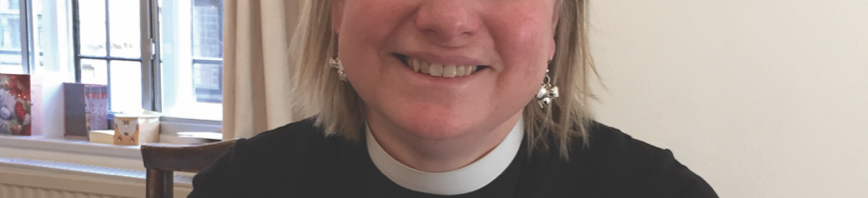
by Jessica Martin, Canon Residentiary at Ely Cathedral. Her book Holiness and Desire (Canterbury Press, 2020) explored the relationship between human and divine desire in an age of commodification. The concerns of this article were first explored in the 2021 Bampton Lectures (https://www.theology.oxford.

The pandemic and its lockdowns has had one strange effect for sacramental Christians. It has destabilised the awkward theological truce on the eucharist. In Anglicanism, the range of sacramental understanding has long embraced the widest possible range of positions, from memorialism (“Do this in remembrance of me”) to Real Presence. Our liturgies (from 1549 onwards) gesture towards both and land on neither. The rise both of ecumenism and the parish communion movement have made too much theological clarity undesirable. So we look away, do what we do, and hope the Holy Spirit will supply all deficiencies.
Until, that is, lockdowns forced us to think about it. The eucharist moved online. In the absence of either bread or bodies, in what lay the transforming work of the sacrament? The question became urgent, for a time, much discussed – even within Roman Catholic circles where sacramental orthodoxy is less commodious. The urgency has diminished as people have returned to physical worship, with real bread and even (for some) real wine, but not because the question is answered. Rather, it has made a wider question more visible.
Because, even with restored physical freedoms, we inhabit an image-dominated digital world anyway. Those images hover between and across the boundary between the fully fictive and the representatively ‘real’, blurring the distinction between thought and the material world – just as the more evasive of our sacramental liturgies do.
Even in secular encounter we do not seem to know what constitutes a present, unambiguous action, as distinct from reflecting or representing an action (itself perhaps ‘unreal’) that took place elsewhere. So business meetings online may be ‘real’ meetings taking real-world decisions; but other forms of online encounter claim a freedom from real-world consequences by defining the online world as closer to thought than to action. In such a definition, online speech should have no real-world outworkings, and online images of events no weighty, real-world counterparts. In fact, truth and fakery merge in the online world of represented things – and the shadowlands between the two contain monsters more powerful than they claim.
Meanwhile, sacramental action (in person or online) has at its centre a presence-in-absence, Jesus. That presence-in-absence, the reality of Jesus at the heart of the eucharist, both underpins and fiercely divides our collective understanding of what counts as ‘real’. How significant is ‘the material’ to this?
Is the Real what happens in the transformed believing heart, the bread no more than a materialised idea? Or does the Real lie, not in the bread as bread, but in the performative power of Jesus’s words at the Last Supper: ‘this is my Body: do this in remembrance of me’? In this reading, repeating the divine command within the liturgy gives the words their power to transform what the bread is, from one substance to another. And, in those cases, place, and even time, might not be important. As long as the words were said, and the person listening were participating in the rite at which they were said, any bread might do. (Theological opinions on this differ; but in practice, many eat bread at home at the point of reception onscreen, even when watching a recording of a service celebrated at some other time and in, of course, another place)
Finally, the bread itself may, within that divinely performative liturgical event made by the priest at a particular place and time, be so fused with the absent body of Jesus as to allow no gap at all between the materiality of one and the Real Presence of the other. In such a case an online eucharist, for the one watching, is not a eucharist at which she can receive.
The historic divisions on eucharistic theology underpinning these different positions have had a profound influence on our modern assumptions about the reality status of represented things. That’s too long a story for this article. But we can see how it has come to matter by comparing two activities that are not as different as they seem: the holy Sacrament, and sex.
Sex and sacrament both assume a real encounter with an Other. Yet, for both, though the realness of the encounter is in some sense guaranteed by the sensory apprehension of a material thing (bread, a body), online that material thing must also be, as material, absent. It is represented. How far that representation is presence depends on the reality-status accorded to it.
In the online world, representation is the only presence. Online, the sacrament hopes against hope to convince its participants of the reality status of its representative actions. Sex, on the other hand, is the activity of all activities most represented digitally. It is the focus of the most intense interest and engagement – and of the most contempt and exploitation. Taking the porn industry, for example – the internet’s biggest sexual expression – it is highly reliant on maintaining a boundary between the fictive and the real, because its imaginings are so frequently violent. Just one true example: when 14-year old Rose found video of her real rape by older men online (under the tag ‘teen getting destroyed’) her challenge to the platform, Pornhub, was ignored until she had the bright idea of writing to them, not as herself, but as a lawyer – at which point the platform took that video down. But it blended unnoticeably with the mass of other content similarly tagged: ‘extreme teen abuse’; ‘teen abused while sleeping’. When Pornhub was challenged about providing such content at all, it took refuge in the idea of representation as a form of thought: ‘We allow all forms of sexual expression that follow our Terms of Use, and while some people may find these fantasies inappropriate, they do appeal to many people around the world and are protected by various freedom of speech laws’.
There are many, many Roses – and the boundary’s permeability is also porn’s great promise for its users. Imagining something might be true is the point – transforming, or corrupting – of fantasy. For, at some level, all digital encounter piggybacks on the idea of having reality status, however deniable.
And, in all digital encounter, the ‘real presence’ experience is actually very elusive. In online sacrament as in online sex, the watcher may conclude, at the end, that the Other they sought was no more than a chimera, an ephemeral set of internal brain-to-body responses, with no ‘real’ meeting here to walk the heart into knowledge – heavenly or horrifying, transcendent or disappointed, all fading into the shadows from which it came.
Yet both sex and sacrament, across the centuries, have made very similar kinds of claims to be an irreducible encounter – an encounter of transforming power, to which no calculable value can be assigned. ‘If one offered for love all the wealth of one’s house, it would be utterly scorned’ writes the Bible’s erotic poet (Song of Songs, 8.7). The parallels between meeting God and meeting a lover run throughout humanity’s long history of desire, which is why the reading history of Song of Songs has as much in it about God as about sex. Now that sex is, in almost all its forms, so fully transactional – whether in swiping right, or in matching identity-statuses, or in becoming product as one consumes product technologically – so that only friendship is left as the great desideratum – it is curious to remember a history where human desire, in some circumstances, had no price-tag to it.
This old-fashioned characterisation of desire as literally a priceless quality asks of us another question about its expression online. Because the online medium is not simply a transparent, neutral means for access to experience that would otherwise be remote or inaccessible. Sex and sacrament, in fact, share the same difficulties with the platform: that the ’free’ digital experience automatically monetizes ‘presence’ for gain.
So it’s not good enough to treat the online medium as a fully transparent open window onto experience, as unambiguous in the nature of its seeing as the corporeal gaze of the human eye. Online seeing is an inexplicit transaction to which the seer assents simply by entering the portal. The ‘free’ model for internet encounter, based on the harvesting of customer data, was not an inevitable market model for online presence, but it has become so. It is the dominant mode for all non-physical encounter. And the point about it is that it requires the one who sees to be both consumer and consumed, without ever quite telling its users that the stuff of their lives are its ongoing and continual price. That is why a corporation can peddle the cruel and violent destruction of the young and the corruption of all whose desires are stirred by it, and call it business-as-usual. Just people thinking stuff they would think anyway, monetized. So they say.
And this medium – the speeded up, logical end of a society based upon consumption – is the one into which we have decided to put a most sacred ritual at the centre of which is a body broken and consumed.
When communion re-enacts, in symbol and in narrative, the consumption of a body, it does this out of a conviction that eating people is wrong. Deathly wrong. ‘Their throat is an open sepulchre’ writes the psalmist of the wicked, ‘eating up my people as it were bread’ (Psalms 14 and 53). Jesus (who thought through the language of the psalms), said to his companions, ‘take; eat; this is my body’. He knew what he was doing when he asked people to eat him as if he were bread.
His offer: take me as a sacrifice, in exchange for every act of devouring the human race ever has or ever could make. Take, break and consume me, just as you take, break and consume each other in the commonplace voracity of the world, but learn that my ordinary act of sacrifice is of infinite value because I am also the infinite God. Devour me, in order to be freed of the appalling consequences of your devourings of each other. Eat me, to enter, however briefly, into a world where your needy emptiness no longer drives you to prey upon those around you, freed from the cruelty of your being by the constant gift of my self.
I am not sure that we meant to place the holy eucharist inside the temple to the marketplace gods; but we did. We put it there for consumption (along with a lot of the Church’s other highly marketised ‘missional’ activity). Perhaps by doing it we have become subversives on the marketplace gods’ territory. Or perhaps we are the subverted. The internet is a strange platform upon which to choose to place the ritual that reverses all other greeds.
It might be the boldest thing we could do – placing communion in the heart of all commodification. Or it could be the silliest choice, the most foolhardy. Are we blaspheming? Or are we, urgently hungry, sick of gobbling shadows, filling ourselves with the bread of the Presence?
I don’t know the answer. We took the eucharist online at a tricky time, for terribly practical, sensible reasons – and we are still doing it, because otherwise, in our world dominated by online representation, we feel our physical expressions to be ephemeral, powerless, invisible. If we are not on the internet, we think we are not really present at all.
And – however our merciful God might redeem our terrible choices – there’s something very, very wrong about that.