Tag: Anglicanism

  • Swimming in the Deep End

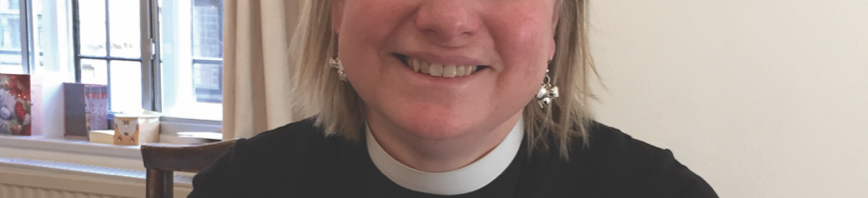
    by Mother Arwen Ffolkes, Vicar of Eastbourne and member of General Synod

    Many years ago, during my discernment process, a conversation turned to the breadth of the Anglican tradition. Someone older and wiser than me remarked, “It is the shallow waters of the pool that always make the most noise.” I have never forgotten those words. Their truth is being borne out in our current time, when some of the loudest voices in our Church seem content to splash about in the shallows. There, amid the noise, hermeneutics, homiletics, and theology are too often reduced to something distressingly thin.

    I fear for some of my campaigning conservative evangelical brothers and sisters. I fear they have lost sight of the deep end and forgotten the joy of learning to swim freely in the vast and generous sea of God. Instead, they insist that those who venture into deeper waters have lost their way, and try to drag us back to the shallows, where the doggy paddle of literalism is the only stroke permitted.

    At General Synod, I often find myself asking: How small is your God? It is a question born not of anger but of grief. I have heard modernisms dressed up as tradition, literal moralism mistaken for orthodoxy, and in all of it, an astonishing blindness to the rotten fruit such distortions bear. Few of the early Christians would have recognised this way of practising the faith. To hang the whole of salvation on the nature of human relationships is perilously close to heresy. How small must one’s God be to imagine that human love could threaten divine holiness or undo redemption? It is not only incredible but tragic.

    I sometimes watch, with sadness, as the self-appointed defenders of God stand firm in their certainties, as if the Almighty needed protection from His own creation. In truth, they have lost their way – not because they are faithless, but because they have mistaken control for conviction and noise for depth.

    Increasingly, I find myself welcoming post-evangelicals who have outgrown the shallows. Life, in all its mess and mercy, has made the pool too small to hold their humanity. Instead of being cast out, they have swum upward and outward – to the deep end – where mystery and unknowing, silence and sacrament, become gifts rather than threats. There, they discover the God who truly walked among us: the One who meets us not in fear but in freedom, not in certainty but in communion.

    The beauty of Anglican faith lies in the holistic dance of Scripture, tradition, and reason – each speaking to experience with grace, charity, and love. It is not shallow. It is not new. It is the deep, living current of the early Church, flowing still, calling us to swim further in.


  • What is The Church of England Evangelical Council Up To? Some Autobiographical Reflections

    by Charles Read, a priest in the Diocese of Norwich and a  former member of General Synod who works in theological and ministerial education across East Anglia and continental Europe

    In its response to Living in Love and Faith (LLF), The Church of England Evangelical Council (CEEC) has said that evangelicals need separate structures in the Church of England. This has puzzled many people, including many evangelicals.

    CEEC was set up in the 1960s by John Stott. The evangelical wing of the Church of England had been in decline for some time. You might trace this back to the very negative and reactionary response of evangelicals to the later Oxford Movement in the 19th century but certainly by the 1920s the future in the Church of England was Anglo-Catholic with great congresses and Prayer Book revision which leaned in a clearly Catholic direction.

    The evangelical resurgence came after the Second World War and by the 1960s was growing, but evangelicals remained a minority voice in the Church of England. John Stott, rector of All Souls Langham Place in London, was acknowledged as the leader of this growing section of the church. One of the things which Stott was good at was organising and putting in place structures of support. He founded CEEC to bring different evangelical groups together for networking and support. It was not a campaigning group in those early days, and has only become so quite recently.

    I was born in the 1960s in a single-parent family in a fairly prosperous village in Staffordshire, although our family was not at all prosperous and we lived in some of the very small amount of rented accommodation in the village. The only religious options in the village were the Methodist Chapel and the Church of England church. This latter was evangelical in its tradition with strong evangelical patronage from the Martyrs’ Memorial Trust. However, like most evangelical Anglican churches at the time, it had a clear vision of being there for everybody in the community. So although my family were not churchgoers on a regular basis, apart from my uncle and his wife who were Salvationists, I was duly baptised in this local church.

    When the vicar introduced a Family Service once a month, my mother took me along. (It was evangelicals who invented family services in the 1960s.) She sent me to Sunday school on the other Sundays but by the time I got to secondary school I had lapsed out of this. I started going to the school Christian Union because it was somewhere warm to go during the long lunch break! It was run by the head of RE who happened to be a Reader in the village church where I lived. He persuaded me to go to the church youth group (Pathfinders) on a Sunday morning and it was through the ministry of this group that I became a Christian in 1973.

    Growing up in this kind of evangelical Anglican church, I recall that we did not expect a bishop to share our theological convictions. We were only three miles from Lichfield but did not see the Bishop of Lichfield very often. We welcomed him warmly when he came and we took people off to the cathedral for confirmation, including me. We assumed that bishops would be theologically liberal and liturgically Catholic and we had no problem with that – it was just how it was. When Maurice Wood became Bishop of Norwich in 1971 there was much rejoicing that an evangelical had become a diocesan Bishop. (People did not generally think back to Ryle in Liverpool some decades earlier or to the 19th century evangelical bishops.)

    From this sketch of my early experiences of church life as a child and teenager, I hope you might see the fact that evangelicals like us were happy to be who we were in a church where we were a minority, and where we did not expect to find bishops, archdeacons or diocesan staff who shared our theological views. We just got along with such people, and in the parish we got on with preaching a message of God’s love and salvation open to all, if they would simply turn to God and accept Jesus as their saviour. I was never aware of being rejected because I came from a single-parent family and my unmarried mother was never rejected by the local church either. This is a far cry from the judgmentalism of the first CEEC video which was produced in response to LLF where, in passing, at least one participant speaks about children growing up in single-parent families ending up in a life of delinquency and crime because of the absence of a father. I am afraid that I did not get the memo and so, rather than enter a life of crime and anti-social behaviour, I became a Christian and ended up in full-time Christian ministry as a priest. I can only apologise to CEEC that I missed my preordained vocation. I am too old now to embark on a spree of delinquency but I am doing my best to cause disruption at Diocesan Synod and I hope that will do.

    We did not, in those days, want or ask for separate structures in order to flourish. Gradually, we learned how to work within the structures of the Church of England and to bring some evangelical witness into things. Many of us learned to appreciate things in other parts of the Church of England which we evangelicals did not have. It’s true that evangelicalism was probably more united then than it is today, even within one denomination. When Anglican evangelicals met evangelicals from other denominations we found we might disagree over things like infant baptism but we put such disagreements to one side. (With the re-emergence of Charismatic Christianity in the 1960s, a fault line did appear amongst Anglican evangelicals.) Nowadays it is common to think that there might be several different tribes of Anglican evangelicals and often they are not speaking to each other very much.

    The CEEC was supposed to bring these different tribes together but in fact has become increasingly associated with the conservative evangelical tribe. It has long since ceased to represent the breath of evangelicalism within the Church of England. As such, its claim to speak for evangelicals in the Church of England is difficult to take seriously. Very few evangelical bishops are associated with it (and there are a lot more of them now than there were in 1971!).

    We managed with bishops who were theologically and liturgically different from us and we never thought it would be appropriate to insist on a Bishop who thought and worshipped in the way that we did. This was all part of being committed to being part of the Church of England. In more recent years, evangelical Anglicans have not needed separate structures over such issues as divorce and remarriage and very few have opted into the provision of a ‘flying Bishop’ – largely because most Anglican evangelicals support the ordination of women. The suggestion from CEEC that we have separate bishops and separate structures in the light of LLF is truly puzzling, not least to those of us who have grown up evangelical. Is this an attempt at setting up a pure church? Who knows – but it is a novel move within Church of England evangelicalism. I am glad to have come to faith and grown up in the welcoming, inclusive and truly Anglican evangelicalism of my youth. I do not recognise myself or this type of evangelicalism in the pronouncements of CEEC.


  • Real Presence in Sex and Sacrament

    Real Presence in Sex and Sacrament

    by Jessica Martin, Canon Residentiary at Ely Cathedral. Her book Holiness and Desire (Canterbury Press, 2020) explored the relationship between human and divine desire in an age of commodification. The concerns of this article were first explored in the 2021 Bampton Lectures (https://www.theology.oxford.ac.uk,/article/bampton-lectures-11 ) and are explored in The Eucharist in Four Dimensions (Canterbury Press, summer 2023).

    The pandemic and its lockdowns has had one strange effect for sacramental Christians.  It has destabilised the awkward theological truce on the eucharist. In Anglicanism, the range of sacramental understanding has long embraced the widest possible range of positions, from memorialism (“Do this in remembrance of me”) to Real Presence. Our liturgies (from 1549 onwards) gesture towards both and land on neither. The rise both of ecumenism and the parish communion movement have made too much theological clarity undesirable. So we look away, do what we do, and hope the Holy Spirit will supply all deficiencies.

    Until, that is, lockdowns forced us to think about it. The eucharist moved online. In the absence of either bread or bodies, in what lay the transforming work of the sacrament? The question became urgent, for a time, much discussed – even within Roman Catholic circles where sacramental orthodoxy is less commodious. The urgency has diminished as people have returned to physical worship, with real bread and even (for some) real wine, but not because the question is answered. Rather, it has made a wider question more visible.

    Because, even with restored physical freedoms, we inhabit an image-dominated digital world anyway. Those images hover between and across the boundary between the fully fictive and the representatively ‘real’, blurring the distinction between thought and the material world – just as the more evasive of our sacramental liturgies do.

    Even in secular encounter we do not seem to know what constitutes a present, unambiguous action, as distinct from reflecting or representing an action (itself perhaps ‘unreal’) that took place elsewhere. So business meetings online may be ‘real’ meetings taking real-world decisions; but other forms of online encounter claim a freedom from real-world consequences by defining the online world as closer to thought than to action. In such a definition, online speech should have no real-world outworkings, and online images of events no weighty, real-world counterparts. In fact, truth and fakery merge in the online world of represented things – and the shadowlands between the two contain monsters more powerful than they claim.

    Meanwhile, sacramental action (in person or online) has at its centre a presence-in-absence, Jesus. That presence-in-absence, the reality of Jesus at the heart of the eucharist, both underpins and fiercely divides our collective understanding of what counts as ‘real’. How significant is ‘the material’ to this?

    Is the Real what happens in the transformed believing heart, the bread no more than a materialised idea? Or does the Real lie, not in the bread as bread, but in the performative power of Jesus’s words at the Last Supper: ‘this is my Body: do this in remembrance of me’? In this reading, repeating the divine command within the liturgy gives the words their power to transform what the bread is, from one substance to another. And, in those cases, place, and even time, might not be important. As long as the words were said, and the person listening were participating in the rite at which they were said, any bread might do. (Theological opinions on this differ; but in practice, many eat bread at home at the point of reception onscreen, even when watching a recording of a service celebrated at some other time and in, of course, another place)

    Finally, the bread itself may, within that divinely performative liturgical event made by the priest at a particular place and time, be so fused with the absent body of Jesus as to allow no gap at all between the materiality of one and the Real Presence of the other. In such a case an online eucharist, for the one watching, is not a eucharist at which she can receive.

    The historic divisions on eucharistic theology underpinning these different positions have had a profound influence on our modern assumptions about the reality status of represented things. That’s too long a story for this article. But we can see how it has come to matter by comparing two activities that are not as different as they seem: the holy Sacrament, and sex.

    Sex and sacrament both assume a real encounter with an Other. Yet, for both, though the realness of the encounter is in some sense guaranteed by the sensory apprehension of a material thing (bread, a body), online that material thing must also be, as material, absent. It is represented.  How far that representation is presence depends on the reality-status accorded to it.

    In the online world, representation is the only presence. Online, the sacrament hopes against hope to convince its participants of the reality status of its representative actions. Sex, on the other hand, is the activity of all activities most represented digitally. It is the focus of the most intense interest and engagement – and of the most contempt and exploitation. Taking the porn industry, for example – the internet’s biggest sexual expression – it is highly reliant on maintaining a boundary between the fictive and the real, because its imaginings are so frequently violent. Just one true example: when 14-year old Rose found video of her real rape by older men online (under the tag ‘teen getting destroyed’) her challenge to the platform, Pornhub, was ignored until she had the bright idea of writing to them, not as herself, but as a lawyer – at which point the platform took that video down. But it blended unnoticeably with the mass of other content similarly tagged: ‘extreme teen abuse’; ‘teen abused while sleeping’. When Pornhub was challenged about providing such content at all, it took refuge in the idea of representation as a form of thought: ‘We allow all forms of sexual expression that follow our Terms of Use, and while some people may find these fantasies inappropriate, they do appeal to many people around the world and are protected by various freedom of speech laws’.

    There are many, many Roses – and the boundary’s permeability is also porn’s great promise for its users. Imagining something might be true is the point – transforming, or corrupting – of fantasy. For, at some level, all digital encounter piggybacks on the idea of having reality status, however deniable.

    And, in all digital encounter, the ‘real presence’ experience is actually very elusive. In online sacrament as in online sex, the watcher may conclude, at the end, that the Other they sought was no more than a chimera, an ephemeral set of internal brain-to-body responses, with no ‘real’ meeting here to walk the heart into knowledge – heavenly or horrifying, transcendent or disappointed, all fading into the shadows from which it came.

    Yet both sex and sacrament, across the centuries, have made very similar kinds of claims to be an irreducible encounter – an encounter of transforming power, to which no calculable value can be assigned. ‘If one offered for love all the wealth of one’s house, it would be utterly scorned’ writes the Bible’s erotic poet (Song of Songs, 8.7). The parallels between meeting God and meeting a lover run throughout humanity’s long history of desire, which is why the reading history of Song of Songs has as much in it about God as about sex. Now that sex is, in almost all its forms, so fully transactional – whether in swiping right, or in matching identity-statuses, or in becoming product as one consumes product technologically – so that only friendship is left as the great desideratum – it is curious to remember a history where human desire, in some circumstances, had no price-tag to it.

    This old-fashioned characterisation of desire as literally a priceless quality asks of us another question about its expression online. Because the online medium is not simply a transparent, neutral means for access to experience that would otherwise be remote or inaccessible.  Sex and sacrament, in fact, share the same difficulties with the platform: that the ’free’ digital experience automatically monetizes ‘presence’ for gain.

    So it’s not good enough to treat the online medium as a fully transparent open window onto experience, as unambiguous in the nature of its seeing as the corporeal gaze of the human eye. Online seeing is an inexplicit transaction to which the seer assents simply by entering the portal. The ‘free’ model for internet encounter, based on the harvesting of customer data, was not an inevitable market model for online presence, but it has become so. It is the dominant mode for all non-physical encounter. And the point about it is that it requires the one who sees to be both consumer and consumed, without ever quite telling its users that the stuff of their lives are its ongoing and continual price. That is why a corporation can peddle the cruel and violent destruction of the young and the corruption of all whose desires are stirred by it, and call it business-as-usual. Just people thinking stuff they would think anyway, monetized. So they say.

    And this medium – the speeded up, logical end of a society based upon consumption – is the one into which we have decided to put a most sacred ritual at the centre of which is a body broken and consumed.

    When communion re-enacts, in symbol and in narrative, the consumption of a body, it does this out of a conviction that eating people is wrong. Deathly wrong. ‘Their throat is an open sepulchre’ writes the psalmist of the wicked, ‘eating up my people as it were bread’ (Psalms 14 and 53). Jesus (who thought through the language of the psalms), said to his companions, ‘take; eat; this is my body’.  He knew what he was doing when he asked people to eat him as if he were bread.

    His offer: take me as a sacrifice, in exchange for every act of devouring the human race ever has or ever could make. Take, break and consume me, just as you take, break and consume each other in the commonplace voracity of the world, but learn that my ordinary act of sacrifice is of infinite value because I am also the infinite God. Devour me, in order to be freed of the appalling consequences of your devourings of each other.  Eat me, to enter, however briefly, into a world where your needy emptiness no longer drives you to prey upon those around you, freed from the cruelty of your being by the constant gift of my self.

    I am not sure that we meant to place the holy eucharist inside the temple to the marketplace gods; but we did. We put it there for consumption (along with a lot of the Church’s other highly marketised ‘missional’ activity).  Perhaps by doing it we have become subversives on the marketplace gods’ territory. Or perhaps we are the subverted. The internet is a strange platform upon which to choose to place the ritual that reverses all other greeds.

    It might be the boldest thing we could do – placing communion in the heart of all commodification. Or it could be the silliest choice, the most foolhardy. Are we blaspheming? Or are we, urgently hungry, sick of gobbling shadows, filling ourselves with the bread of the Presence?

    I don’t know the answer. We took the eucharist online at a tricky time, for terribly practical, sensible reasons – and we are still doing it, because otherwise, in our world dominated by online representation, we feel our physical expressions to be ephemeral, powerless, invisible. If we are not on the internet, we think we are not really present at all.

    And – however our merciful God might redeem our terrible choices –  there’s something very, very wrong about that.


  • Faith and Generosity in the Church: The Via Media, or Transphobia?

    by Revd Nathanael Hayler, Deacon, serving as Assistant Curate in rural Northumberland 

    Why do you remain faithful to a volatile institution?

    How do you show generosity to a hostile Church?

    These remain some of the pressing questions I am often asked when I share my story of journeying towards ordination in the Church of England as a transgender person. They are questions I grapple with in these early years of ordained ministry and will continue to ask as my sense of vocation grows and flourishes.

    As part of my ordination training, I was able to embark on a course of postgraduate study. I developed a project exploring how the Church of England has engaged with the experiences of trans people, both in the context of the local church and more broadly as an institution. Entitled ‘Thresholds of Faith and Identity: A critical analysis of the Church of England on transgender identities’, the piece aimed to prayerfully and creatively theologically reflect on where the Church is now, how it has reached that place and, importantly, what comes next – ‘towards a distinctively Anglican transgender theology.’

    The study and dialogue addresses topics of liturgy and worship, leadership and representation, and pastoral practice. Using theological language and reflective dialogue might feel dense and complex, but I intentionally grounded all my work in practice, always looking to ministry on the ground and to the experience of transgender Christians. Sometimes work on trans identities can be seen as “woke” or niche but the reality is that most of us, whether we know it or not, will encounter or walk alongside a trans person. This conversation is pressing, it is poignant, it is necessary. My research took place in the context of discussions encouraged by the Living in Love and Faith (LLF) conversations. There is a danger that this valuable LLF work will lose momentum and fizzle out; this conversation must continue in creative, engaging, and accessible ways.

    Understanding the need to remain faithful to Anglican convention felt important if this work was to go anywhere. Pushing towards action whilst working within the categories of scripture, reason and tradition offers an effective yet comfortable way the Church of England might begin to develop a coherent theology rooted in the lived experience of transgender individuals. However, there are immediate barriers that currently prevent such progress being made. Firstly, the ambiguity and contradictions that characterise the Church of England’s current position. For example, it is hard to take seriously sentiments that trans and non-binary people are welcome to explore a vocation to ordained ministry when another document prohibits the ministry of transgender people, believing we are not wholesome examples or stable enough to serve as deacons, priests, and bishops (Some Issues in Human Sexuality, 2013).

    Secondly, the Via Media that characterises the Anglican way is often sorely, even dangerously, misunderstood. Despite via media being seen as a virtuous existence for the Church, it is often misused; today it has fostered a culture of ambivalence and mere tolerance. The Church of England is still “sitting on the fence” in offering two very different views that can be ‘properly held’ by Anglicans on the topic of transgender identities. This gross misuse of the ‘middle way’ condones and even encourages transphobic attitudes and discriminatory behaviours toward trans people. The lack of clear guidelines, of both doctrinal belief and pastoral conduct, allows individuals holding authority to freely discriminate or be complicit in keeping silent in the face of such behaviour.  With gender identity legally (in the UK) understood as a protected characteristic and in seeking to treat trans people with dignity and respect, this current manifestation of transphobia disguised as holding the generous via media must be eradicated immediately.

    Instead of loathing the rich diversity that trans and non-binary people bring to our churches, we have an opportunity to celebrate it. And in this celebration we are invited to reimagine what it means to hold the middle way and re-embrace the Anglican tradition of via media in our time; building on the foundations of what has been handed on and always rooting our practice in the life of Christ. Therefore, instead of threatening our sense of self and our convictions, these differences encountered within the breadth of Anglicanism should move us toward a living embodiment of the ‘Way’. That is, Christ: the Way, the Truth and the Life (John 14:6). Christ’s ministry reveals a most beautiful interplay between charity and justice. Rather than seeing the via media as only a charitable gesture, seeking to please both those at the extremities and those at the margins, the via media could be a middle way that seeks to walk the path of both charity and justice – just as Christ himself inspires us to do. If we truly embrace our part in being a living tradition, by faith, we make space for the transformative work of the Holy Spirit, trusting that God will make a way in us and through us.

    As a transgender person, I don’t believe the Church currently recognises the sacredness of trans narratives as part of the living Christian story. I hope, one day, that hearing the experiences of transgender individuals will be understood as a transformative gift. As an ordained person, which very often feels like a scary and vulnerable public ministry, I want to encourage the Church not to neglect this important topic, because of we do that then we neglect our duty of care for the many lives touched by this. There is much work for the Church of England to do if it genuinely desires to welcome and encourage ‘the unconditional affirmation of trans people, within the body of Christ’ and rejoice in that diversity.

    So, I return to those first questions.

    Why do you remain faithful to a volatile institution?

    How do you show generosity to a hostile Church?

    Why? Because I believe in the transforming work of God in the Church of England, and I want to be part of that work. How? By the grace of God alone. Let’s not forget to pray. Pray for the work of the Spirit in the Church, so that one day God’s love will be shared freely and lavishly amongst all people.

    I’m currently exploring options for publishing my research, in the hope that it will be built upon and used to further conversation and provoke change.